
What Actually Happens During Altitude Sickness, and When to Worry
- Endura Medical
- Jun 30
- 6 min read

Most people who set out to climb Kilimanjaro will feel the altitude at some point. A headache here, a poor night of sleep there. For the great majority, it stays mild and passes. But altitude sickness sits on a spectrum, and the difference between a rough night and a real emergency can come down to a few quiet warning signs. Here is what is actually happening inside your body when you go high, how to tell normal from dangerous, and exactly when to act.
Why altitude affects the body at all
The air at the summit of Kilimanjaro holds about half the oxygen of the air at sea level. The percentage of oxygen in the air is the same, but the pressure pushing it into your lungs and blood is much lower, so every breath delivers less oxygen. Your body notices quickly and begins to adjust. You breathe faster and deeper, your heart works a little harder, and over several days your blood starts to carry oxygen more efficiently.
This process is called acclimatisation, and it is the reason a slow climb is safe. Altitude sickness happens when you climb higher than your body has had time to adjust to. The mountain is not punishing the unfit or the unlucky. It is simply responding to how fast you went up.
Acute Mountain Sickness: the common, mild form
The mildest and most common form is Acute Mountain Sickness, usually shortened to AMS. It tends to appear six to twenty-four hours after climbing to a new height, generally above 2,500 metres. The classic picture is a headache, often worse in the morning, joined by some mix of nausea or loss of appetite, tiredness out of proportion to the effort, dizziness, and broken sleep. If you have ever had a bad hangover without the night out to earn it, that is roughly what mild AMS feels like.
Here is the important part. AMS is usually mild, and it usually settles with rest, fluids, and simple pain relief, as long as you stop going up. It is best understood as a warning light, not a small problem to push through. The single most useful rule in all of altitude medicine is this: if you have symptoms of altitude sickness, do not climb higher until they have gone. Most serious cases begin as ordinary AMS in someone who kept ascending.
When it becomes dangerous: HACE and HAPE
Two conditions are the reason altitude is treated with real respect. Both are uncommon, both can develop from untreated AMS, and both are medical emergencies.
The first is High Altitude Cerebral Edema, or HACE, which is swelling of the brain. The signal to watch for is a change in how someone walks and thinks. They become unsteady on their feet, as if mildly drunk, and may grow confused, unusually drowsy, or behave out of character. A simple field check is to ask the person to walk heel to toe in a straight line. If they cannot, treat it as HACE until proven otherwise.
The second is High Altitude Pulmonary Edema, or HAPE, which is fluid building up in the lungs. Here the warning is breathlessness that does not match the effort: someone gasping at rest, or unable to keep up on ground that should feel easy, often with a cough that may turn frothy and a feeling of tightness or drowning. HAPE is the leading cause of death from altitude illness, and it can advance frighteningly fast.
For both, the treatment is the same, and it is not subtle. The person needs to go down. Descent is the one intervention that reliably reverses these conditions. Oxygen and certain medicines can buy time and make the descent safer, but they are not a reason to stay high. Going down, even a few hundred metres, is what saves lives.
When to worry: the signs that mean act now
If you see any of the following, treat it as an emergency and begin descending straight away. These are the signs that separate a manageable illness from a dangerous one.
Red flags: descend now and get help • An unsteady walk, or being unable to walk heel to toe in a straight line • Confusion, strange behaviour, or unusual drowsiness • Breathlessness at rest, or a cough that will not settle • Blue lips or fingertips • Symptoms that keep getting worse, or do not improve after a day at the same height |
The rule that ties all of this together is simple enough to remember when you are tired and cold: when in doubt, go down. No summit is worth more than the person trying to reach it, and a climb cut short can always be tried again.
How to lower your risk before you ever feel ill
Most altitude sickness is preventable, and prevention is far easier than treatment. A few habits make a real difference:
• Climb slowly, and choose a route with enough days to acclimatise. The extra day on the mountain is the cheapest insurance you can buy.
• Where you can, climb high and sleep low. Gain height during the day, but return to a lower camp to sleep.
• Drink enough water and keep eating, even when your appetite fades at altitude.
• Learn the early signs in yourself and in others, and take them seriously rather than pushing through.
• Speak to a travel or mountain medicine doctor before you go. For some climbers there are preventive medicines worth discussing, and personal advice always beats a one-size-fits-all rule.
Help on the mountain: Endura Medical
Knowing the signs is one half of staying safe. Being able to reach proper medical care quickly is the other, and on a mountain that has never been simple. This is the gap Endura Medical exists to close.
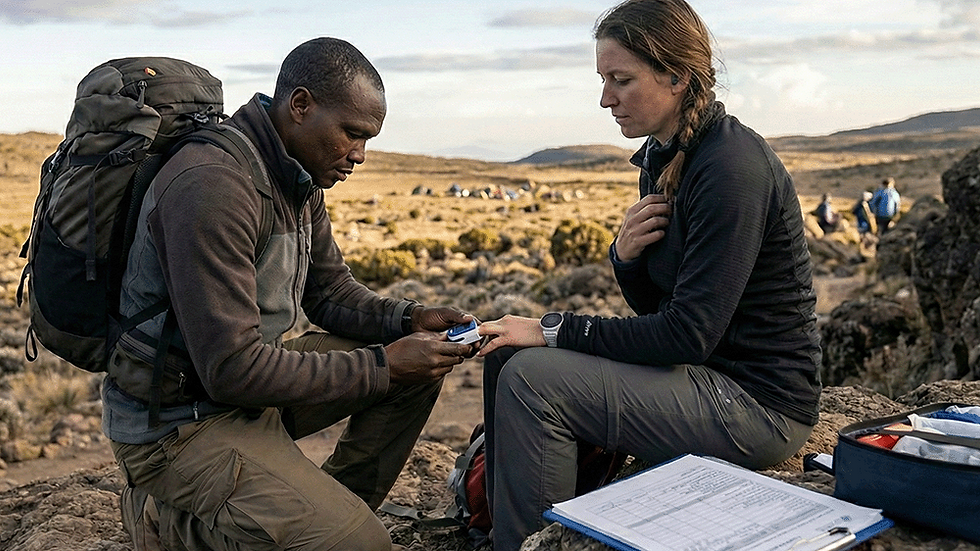
Our High Altitude Clinics sit on Kilimanjaro itself, so that a climber who falls ill or is injured can be assessed and treated on the mountain, by trained medical staff, rather than waiting out the long journey down to reach help. Alongside the clinics, our team supports guides and operators with round-the-clock medical advice and telemedicine, so that a worrying symptom at a remote camp can be talked through with a clinician and the right call made early.
For trip operators, our Climber Season Coverage plan puts that support in place for an entire climbing season. It is built for the companies who put climbers on the mountain week after week and want dependable medical cover behind every group, rather than scrambling to arrange care when something goes wrong. If you run expeditions on Kilimanjaro and want to talk about coverage for the season ahead, we would be glad to hear from you.
Climb with support you can reach Altitude sickness is common, usually mild, and almost always manageable when it is caught early. Learn the warning signs, respect the simple rule of going down when in doubt, and climb with medical support that is actually on the mountain with you. Learn more about our High Altitude Clinics and the Climber Season Coverage plan at enduramedical.co, or contact us at info@enduramedical.co. |
Quick answers to common questions
At what altitude does altitude sickness start?
Symptoms usually begin above about 2,500 metres, although it varies a great deal from person to person. On Kilimanjaro, most climbers first notice it at the higher camps.
How long does altitude sickness last?
Mild AMS often settles within a day or two if you stop climbing and rest. Symptoms that last longer, or that get worse, are a reason to descend and seek medical help rather than wait.
Can you prevent altitude sickness?
You cannot guarantee it, but a slow ascent, good hydration, and recognising the early signs reduce the risk a great deal. Some climbers also benefit from preventive medicine prescribed by a doctor before the trip.
Does being fit protect you?
Not really. Fitness helps you enjoy the climb, but altitude sickness can affect anyone, including very fit and experienced climbers. How fast you go up matters far more than how fit you are.
This article is for general education and does not replace personal medical advice. If you are planning a climb or managing a health condition at altitude, please speak with a qualified clinician.


Comments